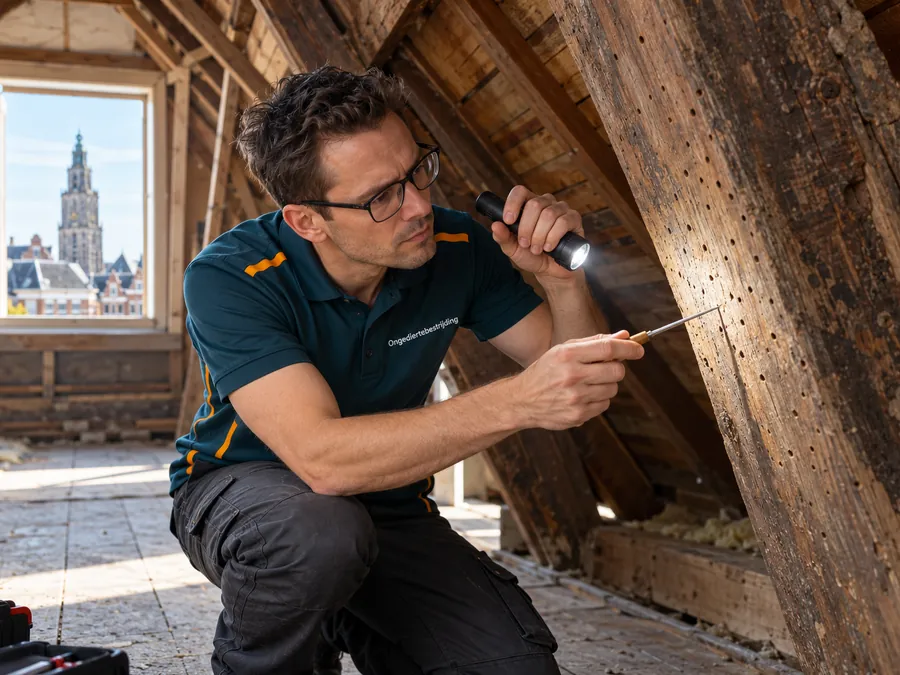
Woodworm treatment in Groningen: what is in the wood?
Woodworm is not a worm but the larva of a beetle, most commonly the common furniture beetle. Its larvae tunnel through timber for years, and only when the adult beetle emerges do you see a round hole of one to two millimetres with a little bore dust beneath it. What shows on the surface is only a small part of the damage.
The house longhorn beetle is a different matter. It mainly attacks softwood in roof structures, makes larger oval holes and can seriously weaken beams. In old oak that has been damp for a long time, the deathwatch beetle may also be present. Which beetle it is determines the approach.
Active or old? Telling the difference
Many old buildings have holes in beams or floors that are decades old, and that is no reason to panic. What matters is whether larvae are still living in the wood. Look out for these points:
- Fresh bore dust is pale and as fine as icing sugar; old dust is dark and caked.
- New holes have sharp, light-coloured edges; old ones are dark and dusty.
- Holes that go through a layer of paint appeared after it was painted.
- With active woodworm, new holes appear in spring and summer.
How we carry out woodworm treatment
During the inspection we identify the beetle, how far the damage extends and whether it is still active. We tap and probe the timber and measure moisture content where needed, because damp wood helps the larvae. If treatment is required, we apply a professional product on or into the affected wood; only a certified pest controller may do this.
Where beams are already badly weakened, we recommend bringing in a carpenter or builder to strengthen or replace them. We also discuss how to deal with damp and improve ventilation, so the wood becomes less attractive. Woodworm is a specialist part of our pest control in Groningen.
Damp and ventilation: the hidden cause
The furniture beetle prefers timber that is not quite dry. A crawl space with standing water, a leaking gutter or a loft without ventilation leaves beams and floorboards vulnerable. Treat only the wood and leave the damp problem, and the beetle may be back within a few years.
While inspecting the loft and crawl space, we also keep an eye out for other pests. If we find droppings or gnaw marks, our page on mouse control explains the next step. And if a nest appears between the roof beams in summer, we also take care of wasp nest removal.
What you can do yourself
There is plenty you can keep an eye on. Doing so stops a small infestation from growing unnoticed and means you can tell us exactly what you have seen.
- Cover suspect holes with a piece of tape; if new holes or dust appear later, the woodworm is active.
- Do not paint or varnish over holes, or you will no longer see what is happening.
- Check antique or second-hand furniture before placing it next to other wooden pieces.
- Keep the crawl space dry and the loft well ventilated.
- Do not use a DIY-store product on structural beams without knowing what is going on.